Mostrar mensagens com a etiqueta unit3. Mostrar todas as mensagens

domingo, 30 de maio de 2010

writing reviews on one annotated bibliography and one learning object published by colleagues

Processos Pedagógicos em Elearning
Unit 3: Act 3 - Review of AB & LO

Review on one Learning Object 

Manuel Pimentel presents this Learning Object


I appreciated this LO message, which is clear and well structured.
However the use of the tool Go-Animate seems to put some issues regarding the speed of the speech balloons, sometimes it is hard to read the text. On the other hand I think the number of words that appear in balloons should  be shorter, it would be easier to read.
Another characteristic that I don't appreciate in the tool Go-Animate is the background music, that I believe can distract the reader of the text.
Manuel, congratulations for your good presentation, I really feel that we can learn about transparency in online education from your LO.

Review on one Annotated Bibliography

On unit 1, I chose Ana Marmeleira’s Annotated Bibliography because Ana's work completes my work.
On unit 2, I choose again her AB. If we join the Ana's AB to my AB, as they have different content and style we can achieve a better AB.
On unit 3, I've been waiting for colleagues who have not yet published their AB. However I feel that I should not delay more, so I will review again Ana Marmeleira AB.

Ana AB included four relevant resources and some personal reflections. Has two references that I does not refer in my annotated bibliography and that I think are very interesting:

Para uma Pedagogia do eLearning: o ‘contrato’ como instrumento mediador da aprendizagem, by Lina Morgado; Alda Pereira; Luísa Lebres Aires; António Quintas Mendes (Centro de Estudos em Educação & Inovação – Universidade Aberta) http://medeia.org/files/Pedagogia_eLearning.pdf 
Transparency in online courses can be achieved by an important tool that all of us know well by now – the learning contract. In this article we can find an explanation of how the learning contracts are used in Universidade Aberta as well as its importance to make online learning more transparent.

Moving a Large Course Online: Psychology, posted by Robert Griffiths, shared by Ellen Furlong and Melissa Beers from the Psychology Department of the Ohio State University
"We would encourage instructors interested in teaching online to pay special attention to making structure transparent to students when converting a classroom-based course into an online format." It’s a good example of the importance of transparency in online courses.

Suggestions for improvement. Ana show us a traditional Annotated Bibliography, World Wide Web allow us to create documents containing pictures and videos, so I suggest that Ana include some of these items in her AB. She can also consider to embed some of the good Learning Objects created by our MPeL3 colleagues.

More reviews that involves possible judgement of the works made and that I consider as private matter will be send, in Portuguese language, to the colleagues by private email.

domingo, 16 de maio de 2010

Transparency in Online Education - Learning Object

Processos Pedagógicos em Elearning
Unit 3: Act 2 - Learning Object


In this little story I tried to illustrate the theme "Transparency in Online Education". I tried to use a wide variety of scenarios to communicate that diversity is also important in elearning and that transparency can and should be global.
I also wanted to show the transition of an enclosed school in which most of us learned to open and transparent environment promoted by web 2.0.
I wanted to use tools that are not yet used by other colleagues (As more tools we learn... better for all).
I used Camtasia to make the movie and the acapela.tv for the animated toons.
I felt lot of difficulties due the speed and duration of the toons dialogues.
This object still needs some revisions mainly on the English issues, but also in the script and in the transitions between scenes.

Licença Creative Commons This blog entry and this LO are licensed under a Creative Commons License

domingo, 9 de maio de 2010

Transparency in Online Education / Annotated Bibliography

Unit 3: Activity 1 

 (This image is a wordle of text below)


Transparency in Online Education / Annotated Bibliography


Transparency for Quality

In this presentation the author says that: we can chose betewen transparency or privacy. He argues that transparency improves quality and promotes cooperation, but students shoud be free to choose their individual privacy level.


[3] Transparency in Cooperative Education Online -Christian Dalsgaard and Morten Flate Paulsen, June 2009

The purpose of this article is to discuss the following question: What is the potential of social networking within cooperative online education?
The authors argue that transparency is a unique feature of social networking services. Transparency gives students insight into each other’s actions. Cooperative learning seeks to develop virtual learning environments that allow students to have optimal individual freedom within online learning communities. This article demonstrates how cooperative learning can be supported by transparency. To illustrate this with current examples, the article presents NKI Distance Education’s surveys and experiences with cooperative learning.
This article focus on qualities of social networking  found in services such as weblogs, social networking sites, micro-blogging, and social presence tools. The basic assumption is that transparency is important to cooperative online education. People can cooperate only if they know about each other and have access to some common information and services.

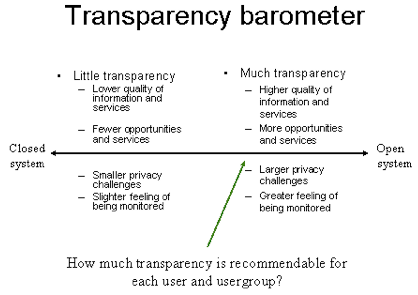
In this article we can find this picture which shows a Transparency Barometer 
(we can also find this picture in a Paulsen article in Seminar.net) 

image


[4] Networks vs. groups in higher education. Anderson, T. (2008) Message posted in the Virtual Canuck blog.

In this blog entry, Terry write about students and network privacy and concludes that "Networks offer increased opportunities for the growth of social capital, for globally relevant distributed learning and for increased involvement and engagement of higher education (...) provide motivation for higher education institutions to move beyond groups."

[5] Teaching as transparent learning by George Siemens (2009) Message posted in the Connectivism  networked and social learning blog.

George Siemens write " iI’ve gained much from being a transparent learner. Over the last nine years – on blogs, wikis, and recently Twitter – I’ve expressed half-formed ideas and received the benefit of constructive (and critical feedback). I generally focus on what I’ve gained, but I suspect readers of my sites and articles have gained something from the experience as well. Putting ideas out for discussion contrasts with formal “reach a conclusion and publish” model.

Watching others learn is an act of learning.
When someone decides to share their thoughts and ideas in a transparent manner, they become a teacher to those who are observing.

The varying cognitive architecture of those who are new to a subject and those with significant experience provides support to the value of peer-to-peer learning. A student who has just started blogging can likely relate better to someone who is still only considering blogging. when we make our learning transparent, we become teachers. Even if we are new to a field and don’t have the confidence to dialogue with experts, we can still provide important learning opportunities to others.


the value of dialogue and discourse in learning can’t be subjugated to the view that all contributions should advance a field. Transparency in expressing our understanding, our frustrations, and our insights helps others who are at a similar stage."

[6] Tranparency in online education  Sónia Valente e Telma Jesus (2010) - mpel3 colleagues
These LO summarize the view of this mpel3 colleagues point off view concerning the Transparency in online education. We can get a quick idea about this topic.  


 [7] Tranparency in cooperative online education José Carlos Figueiredo and Paulo Simões (2010) - mpel3 colleagues.
These LO summarize in enjoyable way one of the benefits of transparency to be able to receive feedback to improve our work and be able to contribute ideas for improving the  others work.


[8] Transparency for Cooperation related [www.seminar.net]
Transparency for Cooperation

Conclusion:

Transparency is fundamental to improving world learning. By sharing we are contributing to a fruitful discussion on the topic. If we receive feedback from others we can improve our work. 
Transparency can also contribute to improving the others work, as they not need to start from zero. They can learn with ours goals, wins and mistakes.
There are Somme issues regarding to transparency level. No one can be forced to be always transparent. Not all people are igual and not all situations are similar.
Students should decide which information each actor (teacher, students, community, world) can see.
Students and tutors have to find a balance between transparency and privacy, regarding that transparency is related to open learning process and more transparency = more cooperative work.
 

Obs: All websites were accessed on May 9, at the time of publication of this post, and the quoted content remained unchanged from the initial readings.